
The further demise of journalism.
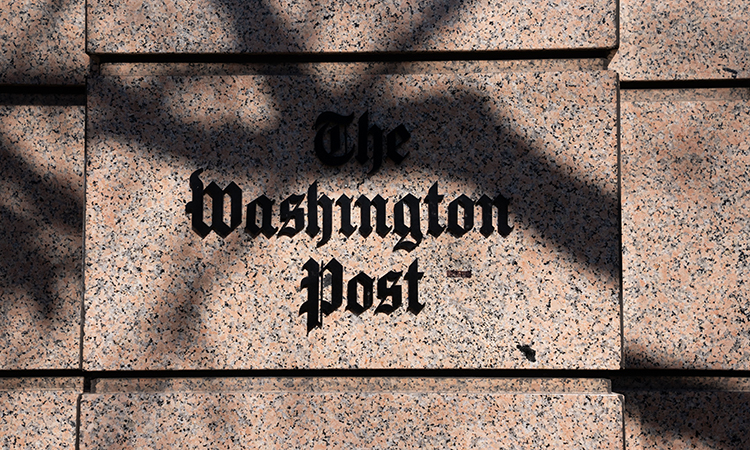
The Washington Post office following a mass layoff, Thursday, Feb. 5, 2026, in Washington. (AP Photo/Allison Robbert)
You might have missed the story last week in which we learned that The Washington Post laid off somewhere between a third and half of its employees. It’s perhaps the biggest one-day journalism bloodbath on record.
Gone is the sports section. Gone are features like book reviews. Gone is the local photography staff. Gone are bureaus in Europe and Asia. It’s the same old story. A newspaper’s readership declines. Business suffers. The newspaper lays off staff. The quality and quantity of content suffers. Readership further declines.
Such has been the story at iconic newspapers in big markets across the United States.
Jeff Bezos, you might recall, bought the Post in 2013. He has yet to make a dime on the purchase. According to reports, the paper lost $100 million in 2025. Even billionaires notice a financial leak of $100 million.
Media reporting places the blame on “the changing landscape in journalism” and the “secular challenges facing the newspaper industry.”
Certainly, those things are factors. Newspapers were particularly vulnerable to the disruption brought about by the advent of the internet. A news website can update itself on the fly in real time and push that update to your phone. A traditional newspaper must ink up a press and then load the printed product on trucks to be delivered to the four corners of the paper’s service area.
Websites like eBay and Indeed.com killed the once immensely profitable classified advertising section.
Those things are real, and they assuredly impacted The Post.
But what the media doesn’t report is that The Washington Post – like most of the “legacy” media industry – long ago devolved into a house organ for the Democratic Party. The paper – either intentionally or by accident – largely quit pretending to be balanced in its reporting.
When Bezos tried to move the paper back to the center, he faced a revolt in his newsroom while many of The Post’s leftist subscribers abandoned the paper in a huff. That’s a bad combination when potential subscribers on the right have long ago written you off.
But unlike most daily papers, The Post’s troubles weren’t inevitable. The Post has the distinction of being in the news junkie capital of the world. Two things are true about Washington, D.C. One, it’s a two-party town. And two, news is consumed there at a voracious rate.
Put out a product that both sides are willing to trust, and you have a business. Write off half of your potential universe, and you have a problem.
This is what happens to businesses that become so arrogant as to believe that they can safely ignore the sensibilities and sincerely held beliefs of half the people in the marketplace (see Gillette and Bud Light).
Even with acknowledged industry challenges, The Post is a unique institution that, by virtue of where it is located and the profile of those who consume it, had the potential to remain financially viable. Instead, it suffered for the fact that though leftists are almost always wrong, they’re never uncertain.






I miss those big ole fold out newspapers. Remember the movies of the bums sleeping on the park bench covered in a single newspaper? TCM is so vital to our history, showing those old movies. Kids now days cannot sleep on a park bench covered in cell phones. What a shame the dang progressive movement has completely and utterly polluted our schools, colleges, and universities. I don’t like these times, at all.
Funny this is being written by a journalist. My granddad always said believe 1/3 of what you read, 1/3 of what you hear and the rest your own experience……he said follow the money in politics.
As one that knows Mr. Gleiser AND has done business with him, let me remind you sir that along with being a journalist, he is also an entrepreneur. IE; one that puts his personal hard earned money or other assets on the line to purchase and operate a business. In this case KTBB. These are the guys that meet the payroll, pay the bills and make the real decisions at a business and take the real heat if necessary. If the business should somehow fail, employees just get other employment.. The entrepreneur on the other hand loses his savings, home, or other valuables. He after all took the risk. I have done same with my business, which starts its 22nd year in April of this year.. Its real easy to sit in the cheap seats, complain or laugh at those that do. It’s another to take the deep breath, swallow hard and put it all on the line. Bezos and Gleiser, and few others understand this. Most don’t
Thank you, Bill.
So, where do we look for actual news now? Over the last week even Fox has hyper saturated the news with minutiae and trivia. I don’t care about celebrity kidnapping. There are actual events that the legacy media is breaking their own spines to get you to ignore with this silly monkey nonsense. I’d love to see a quality replacement.
Journalism died a LONG time ago. But guess I need to be honest and give credit were it is due. My love for reading was sparked by as when I was a little girl my Grandmother would send me out to see if the paper had been thrown yet. Generally it was right on time. Then I would sit on Granny’s lap and she would start on the first page and she would read to me what was fit for a child to hear. The funnies were popular of course. I learned to read from the newspaper before ever being old enough to go to school.
Now days newspapers, for the most part, are nothing more than bird cage liners.
It is too bad that the newspaper era is fast approaching it’s end. I imagine children don’t even know what a newspaper is and that is sad.
In response to Linda Montrose: Yes, I still love a real newspaper, too. Having moved down here from Dallas I loved the Dallas Morning News. I am 76 and long for those days of that great big paper that came every day. Loved it!
Well, when I moved to Kilgore, the paper here got eat up by the internet so I tried the Longview paper. So obviously biased I just could not take it. That was several years ago. I just recently tried that paper again and it was worse than before. Canceled after one month.
I have hope that one day things will turn around and go back to the days of the news-only, printed word of the local news paper. I still miss it so much. It was said the internet would replace the printed book – wrong. Books are still popular because a reader loves that book to hold and read and carry it with you. I hope its not my generation that carries that love of the newspaper to the grave with them.
Thanks for your comment. Made me happy. Thanks to Paul Gleiser who we can all count on.
Diane Lambert