
Who decides?
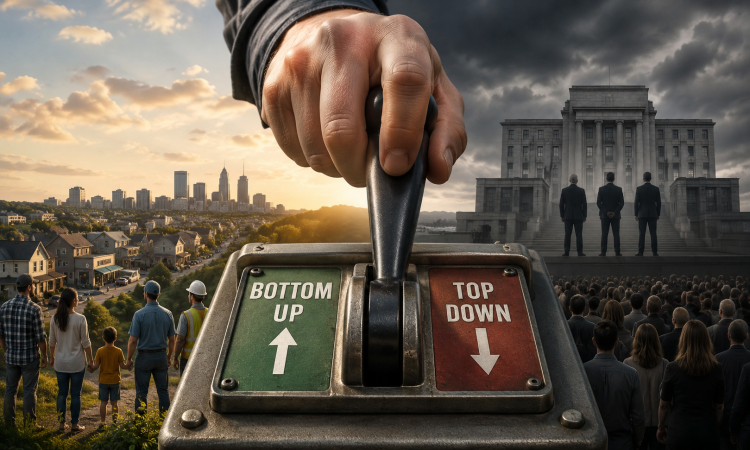
Who decides?
As what I believe is an unusually pivotal midterm election draws near, it strikes me that this midterm is less about the usual partisanship and more about a fundamental question regarding governance.
“Who decides?”
As in, who decides how we order our lives? Do we, as free citizens, decide for ourselves, from the bottom up, through millions of individual choices made by families, workers, entrepreneurs, consumers and communities? Or do we increasingly turn those decisions over to an elite ministerial class that believes it knows better and therefore seeks to govern from the top down?
In 20-plus years of writing these pieces for radio, TV and the web, I have consistently made the case for the former while strongly rejecting the latter.
For nearly two and a half centuries, America has conducted a remarkable experiment in bottom-up decision-making.
“Bottom-up” was a radical idea in 1787 as delegates from the 12 of the original states gathered in Philadelphia to draft the U.S. Constitution. For almost all of history, “top-down” was the default.
The Founders believed that authority should originate from the individual choices of free citizens and move upward. Families should decide what matters to them. Workers should decide where to work. Consumers should decide what to buy. Entrepreneurs should decide what risks to take and be free to allocate capital accordingly. Communities should decide what they value.
Government isn’t absent in this vision, nor could it be. Government’s role is indispensable. But under the American arrangement, it is intended to be the servant of this vast, unruly, decentralized process, not its master.
Bottom-up has never been tidy. In fact, it has often been quite messy and sometimes downright ugly. Free people make mistakes. Markets misallocate. Voters get things wrong.
But the genius of bottom-up decision-making is that mistakes remain dispersed and correction remains possible. Millions of people continuously test ideas against reality. What works spreads. What fails is abandoned.
The results have been compelling. A nation that began as a thinly populated collection of former colonies became the most prosperous and innovative society in human history. Bottom-up America produced astonishing abundance, technological progress, social mobility and individual opportunity.
Contrast this vision with top-down.
Top-down concentrates decision-making in an elite ministerial cohort — politicians, regulators, administrators, academics and credentialed experts — whose defining conviction is that complicated societies can only succeed if sufficiently enlightened people are given sufficient authority to manage them.
The irony considering the 2026 midterm campaign is hard to miss. Many Americans now advocating more top-down control have lived extraordinarily comfortable lives amid the prosperity, freedom and abundance produced by the system they increasingly distrust. They inherited the fruits of bottom-up America and now propose consigning their liberties to the ministers of top-down.
And this should not be overlooked: Every decision transferred upward makes the next transfer easier – until one day there’s nothing left to transfer.
So, forget about party labels. Forget about the likeability or lack thereof of this or that candidate. Instead, ask yourself this one question.
Who decides?
And then vote accordingly.





Summarizing President Lincoln’s comment: that government of, by and for the people might not perish from the earth. Go out and vote.
Within this decade we have seen the horrid and terrible results of top-down ideology. So many Americans killed, businesses destroyed, and our children left to meander in a quagmire of educational sludge were all caused by the elitist mandates of Dr. Fauci (or more accurately, Dr. Mengele 2.0).
What ever happened to Communism being illegal in this country? The law is still on the books, but no enforcement. Everyone with a d*%n cell phone is partially to blame, as is social media and all the propaganda spread on the multiple facets of social media.
The devil and his minions never rest. The rest of us get complacent. We need to talk to our friends and family and tell them to go vote! Their votes do count.
The main difference is: people are not thinking about the over all condition of this country and how as small as what one choice matters, it affects us ALL! Whether it be the price of gas or food no one thinks of the collective, they think of themselves NOT the present and the CHOICES made NOW may not show up til way on down the road. THIS IS THE PROBLEM! NO ONE thinks ahead anymore. Let’s take the depression. People were warned but chose to ignore the signs. They lived as there was no tomorrow and many jumped out of windows because of their life choices. People starved but able bodied men and many young people who were willing to work took what work they could with the government CCC camps building stone buildings all across the country. People today don’t want to work. They rely on the government instead of trying to figure out ways of making things better for themselves and others! My Grandmother made it through the depression by not depending on others to take care of her and five kids. She improvised the best she could with what she could find!
These people in our government had better take a good hard look at the PAST and stop throwing money at problems and really look at the PROBLEMS we have and FIX them! Stop allowing those who are nothing but wolves in sheeps clothing come into our GOVERNMENT meaning to destroy us! FIX the school system making them TEACH not indoctrinate!
Your last sentence sums it all up in a nutshell – parents need to pay attention to what their children are being taught, no – maybe it is more a case of “indoctrination”. Parents? Are you there? Pay attention to the teachers, ask to visit the classroom and sit in the back of the room. Get a sense of what these “teachers” are filling your kids’ heads with!