
Milton Friedman’s simple truths about government spending.
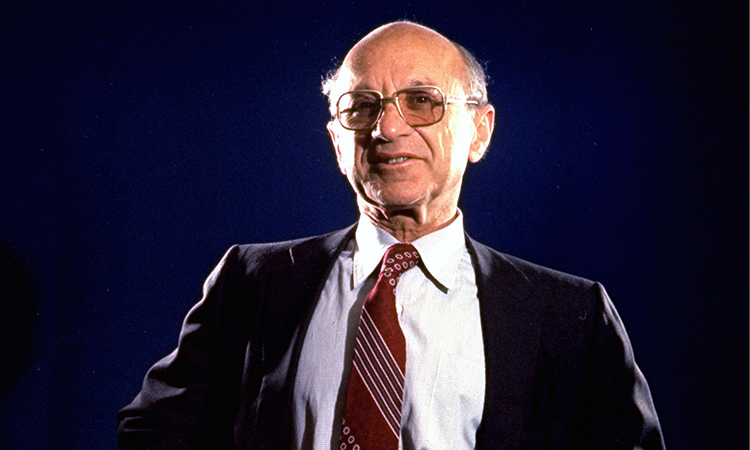
This is a 1977 photo of Dr. Milton Friedman who won the 1976 Nobel Prize for economics. The Nobel-winning economist, who advocated an unfettered free market, died on Nov. 16, 2006. He was 94. (AP Photo/Eddie Adams)
An article by Jim Cardoza at American Thinker reminded me of something I read by economist Milton Friedman. Friedman had an uncanny way of making economics easy to understand. By extension, he makes the divide between conservatives and liberals – and thus this looming midterm election – easy to understand.
Taxation, as Friedman explained, is in its essence the taking of your money to spend on someone else. He then explained the four basic ways that money gets spent.
- The first is you spending your money on yourself. When you spend your money on yourself, you are naturally sensitive to both price and the suitability of what you’re spending it on.
- The second way is your money that you spend on someone else. In that case, you’re sensitive to price but you’re a poor judge as to whether the beneficiary of that spending will find what you’re spending it on suitable.
- The third way is you spending someone else’s money on yourself. In that case you’re very sensitive as to suitability but not so sensitive as to price.
- And fourth is when you spend someone else’s money on someone else. In that case, you’re sensitive to neither price nor suitability.
That last way of spending money is how most taxpayer money gets spent.
Democrats fervently believe in spending your money on someone else. This stands at the core of what separates big government liberals from small government conservatives.
Democrats look at the wealth of the most successful in society (read: “the rich” in Democrat-speak) and see a pile of money that they believe should be presumptively taken and put to use making life better by providing such things as “free” health care, “free” college, “free” or subsidized housing, “free” or low-cost food and all the rest of the liberal smorgasbord of government spending driven by lofty intentions but never held to account for actual results. (Please note the air quotes around the word, “free.” Nothing is free. Someone has to pay.)
Experience tells us that spending someone else’s money on someone else (the very definition of most government social spending) removes both the incentive and the marketplace signals that are prerequisites to spending money wisely.
That’s how you get zillions spent on poverty programs that perversely further entrench poverty, zillions spent on education that results in ever-worsening educational outcomes, zillions spent on housing projects that quickly turn to slums; and so forth and so on all down the depressing list of government social spending programs that have been long on noble intentions but short on good results.
For us conservatives it’s very simple. We believe that experience shows that confiscating the fruits of success from the successful (read: taxation) quickly forecloses the possibility of future success. Taken to its logical conclusion, the ‘money well’ dries up and there’s no longer a “someone else” to pay for the spending.
The economy collapses. Social misery rises. And you wind up with the epic failures of a Soviet Russia, Cuba, or Venezuela.
And that’s what’s really on the ballot November 3.





Well said Paul.
Several years ago, my wife (Ph.D.) and I spent part of the summer on an archaeological dig in Israel. The…
To Mike: Okay, I will try to explain what I heard when someone answered the question, "How the Jewish community…
Let's toss in this explosion of the Democratic Socialist of America a.k.a American Nazi Party. Any of us who have…
Let's call it like it is Paul. It’s anti anyone who is not muslim. Other than that little oversight, good…