
A most important day.
Thursday, September 17 is Constitution Day. Most people don’t know that. We don’t set off fireworks on September 17. Constitution Day goes by every year largely unnoticed.
But that doesn’t mean it isn’t important. In fact, one might argue that Constitution Day is the anniversary of one of the most important things to happen in all the roughly 5,000 years of recorded history.
Constitution Day marks the observance of the day in Philadelphia in 1787 when 39 of the 55 delegates to the Constitutional Convention – who had been working since May in a sweltering room in what is now called Independence Hall – put their signatures on the document that we now call the U.S. Constitution.
Those men couldn’t have known it at the time, but they changed the world.
The Constitution is a monument to word economy. The Congress of today that the Constitution created can’t seem to write a law in fewer than 2,000 pages. The men in Philadelphia launched a great nation in approximately 4,500 words.
To my mind, of those 4,500 words, four particularly stand out.
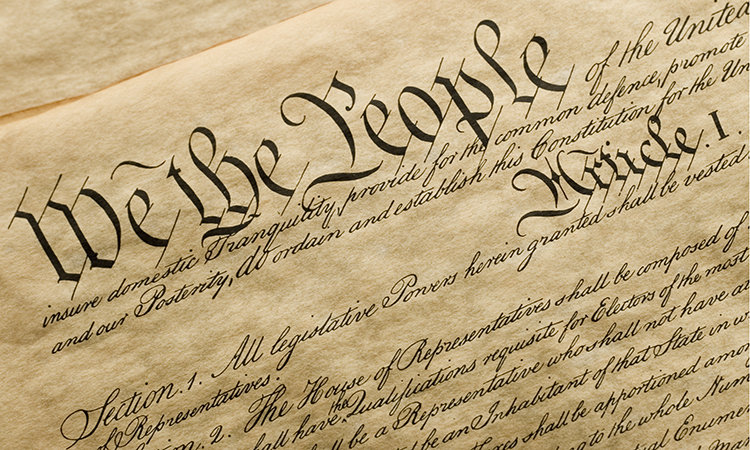
You’d probably guess the first three. They are, “We the People” We’ve all seen the beautiful calligraphy of the Constitution’s preamble. The words, “We the People” are inscribed in script much larger than the text that follows. That’s no accident. It signifies that with respect to the relationship between government and the people, the people stand superior.
That leaves the fourth word. For me, it’s “ordain.” It appears in the final phrase of the preamble and it reads:
[We the People]…do ordain and establish this Constitution for the United States of America.”
The significance of that single word, “ordain” cannot be overstated. In this context, according to Webster, the word means: “To order, establish, or enact something formally by law or high authority.”
In this instance, that high authority is the people themselves, and not a king or emperor or high priest of some sort.
The People.
In that single word, the people claim the authority to create their government. Hereditary title supplies no entitlement to rule them. Military strength supplies no moral warrant. Government’s legitimate authority comes from the people who establish it.
We take that for granted today. It was revolutionary at the time.
To be clear, the Americans of the late 18th century didn’t invent representative government, constitutional restraints, or republicanism. Their achievement was to bring these ideas together at scale. Their innovation was an ambitious federal republic, with a written constitution standing above the ordinary exercise of political power.
We the People identified the source of authority. The institutions that followed divided its exercise. States retain their own governments. No single institution possesses all the instruments of national power.
The Constitution’s shortcomings and contradictions are well documented and often discussed. But too little discussed is the fact that the nation whose government was ordained into existence by its own people became the most prosperous, most successful nation in history.
That fact is neither coincidence nor happenstance.








Several years ago, my wife and I spend much of the summer doing archaeology in the Middle East. One of…
Your last sentence sums it all up in a nutshell - parents need to pay attention to what their children…
I remember that morning very well. I was living in Phoenix, Arizona, preparing to leave for my office when my…
I applaud your commentary today. I enjoyed reading it and agree with it wholeheartedly. Keep up the good work!
Don't think anybody who was there on September11, 2001 can forget what happened, who was responsible, they felt horror that…