
It mattered then. It matters now.
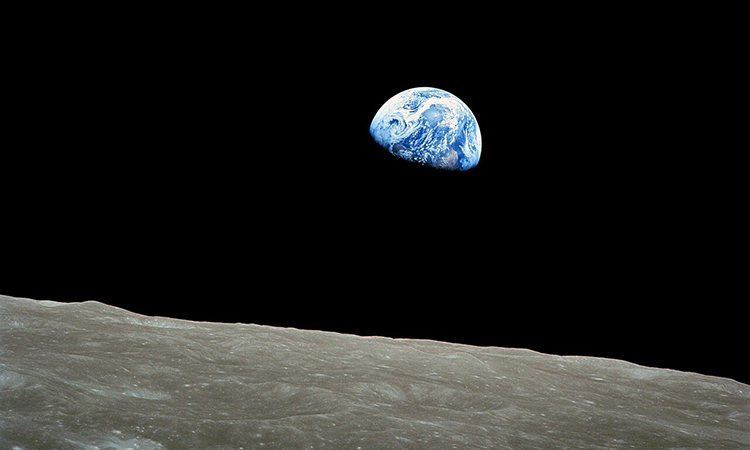
I remember Christmas Eve 1968 like no other Christmas Eve in my life. I was a young boy at the time. Apollo 8, the first ever manned space mission to leave Earth orbit, was orbiting the moon.
The world was following the story, and more than a billion people worldwide were watching that Christmas Eve as the crew conducted a live telecast from the Apollo command module.
As the telecast was concluding, astronauts Frank Borman, Jim Lovell and Bill Anders stunned the world when they began reading from the first chapter of the Book of Genesis. Aside from Borman, Lovell and Anders themselves, no one knew it was coming. Not NASA management. Not the flight controllers in the Mission Operations Control Room. It was a complete surprise.
And it had seismic impact.
That telling of the creation story – by men who were experiencing a perspective on creation in a way like no human in all of history – was riveting. And in that moment – the end of the awful year 1968 in which the Vietnam War raged, riots plagued major American cities and Martin Luther King, Jr. and Robert F. Kennedy were both assassinated – was somehow yet redeemed.
As the story goes, when the crew returned home to Houston, mission commander Frank Borman received a telegram from an anonymous sender saying simply, “Thank you. You saved 1968.”
Fifty-eight years later, and for the first time since December 1972, a manned American mission is again on its way to the moon on a mission profile remarkably similar to that of Apollo 8. Apollo 8 flew 10 orbits around the moon to test the spacecraft in deep space and to validate navigation, crew systems and reentry and recovery procedures – all with an eye toward a future lunar landing mission.
Three American astronauts and one Canadian astronaut are aboard the Artemis II mission in a spacecraft that borrows heavily from the Apollo flight hardware and their mission objectives are nearly identical. The only real difference is that Artemis will slingshot around the moon and immediately head back home, rather than decelerating into lunar orbit.
Though a creation story moment is unlikely on this mission, I nevertheless hope that a successful mission might restore some pride in American accomplishment. Great nations dare to do great things purely for greatness’s sake.
In the 1960s, the world was watching the United States and the Soviet Union – two nations with diametrically opposed views regarding individual and economic freedom – to see which of the two could muster the political, scientific and engineering resources necessary to lead the way in space.
Six decades later, the contest is between the United States and China. And again, the world is watching to see which nation will emerge as the leader.
It mattered then. It matters now. A nation’s prestige has a great deal to do with its ability to shape world events.
Apollo 8 had its detractors, and this mission does, too.
But most of us “got it.” I pray that we “get it” again.






Paul, I get it, too. I pray and pray that the “stupid” (look up the definition of stupid) people in this country get it too. I am so skeptical of those Americans who choose to NOT get it. I’m done with wondering what is wrong with people.
This past Resurrection Day brought me back to the place of seeing this as the evil presence in this world that is battling for control of our destiny.
That is where we all are whether we are believers or nonbelievers. We will all stand in that same place one day in that day of Judgement to stand for what we did in this time.
Dear people, think about how we handle this time of battles, deceit, evil, love and respect for our brothers and all the situations that make up our days. The joy and peace that is here is for us all, “believers and nonbelievers” alike.
Go for it dear people. Let your yes be yes and your no be no. In all things.